Designer armchairs: how to choose the right one for your home
22 October 2026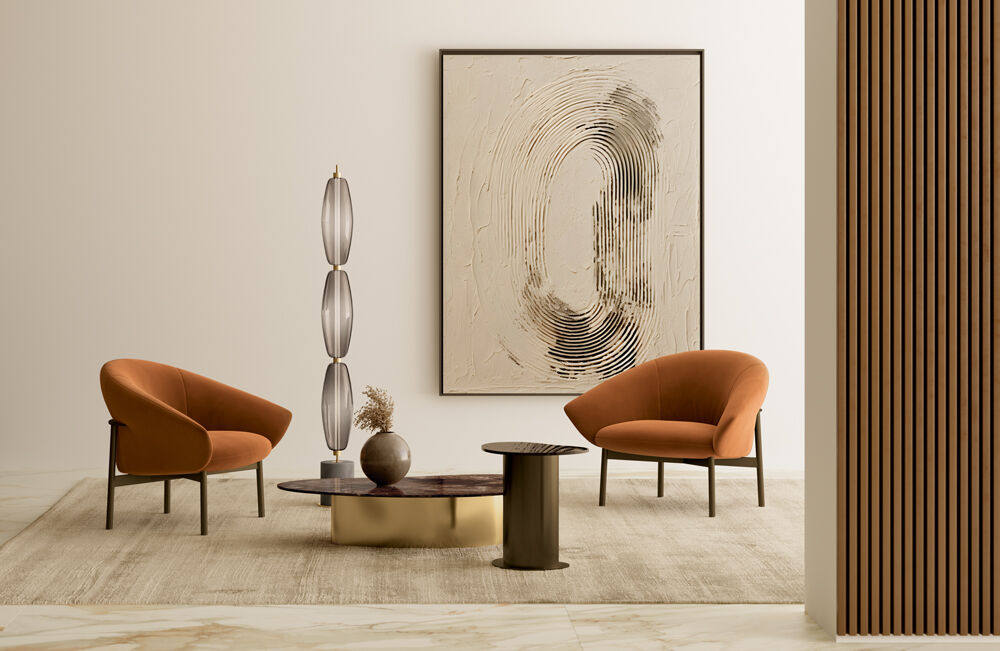

Autumn has a way of drawing us back indoors. The evenings grow longer, the afternoon light fades sooner and there is one spot that fills up again: the armchair. It’s where you finish the book you started on holiday, sip the first hot tea of the season, sit down for ten minutes and then lose track of time.
Armchairs only look like small pieces of furniture. They take up less than a square metre, yet they change the way a room is used: an empty corner becomes a reading nook, a bedroom stops being just the place where you sleep. In this guide we set out how to choose, from the many designer armchairs available, the one that really works in your home, starting with size and moving on to upholstery, by way of a question few people ask themselves before buying: fixed or swivel?
Size: where to really start
Before colour and before fabric, an armchair has to be measured against the room. There are three dimensions to check. Width tells you how much space it takes up against the wall; depth matters more than you might think, because it is what eats into the walkway; backrest height determines how visible the armchair is as you walk into the room. In front of the seat you need at least 60-70 cm of clear space to stand up and walk without sidestepping anything, and if there is a coffee table beside it, it is best kept about 40-45 cm from the edge, the distance at which you can set down a cup without leaning over.
The Bontempi collection covers a wide range of sizes, from the 70 cm width of Lady to the 104 cm of Petra:
| Model | Dimensions (W x D x H) | Versions |
| Petra | 104 x 79 x h 77 cm | Fixed, swivel |
| Kodi | 85 x 91 x h 70 cm | Fixed, swivel |
| Victor | 88 x 88 x h 77 cm | Fixed |
| Doris | 83 x 75 x h 70 cm | Swivel, swivel with return |
| Nova | 72.5 x 70 x h 92 cm | Fixed, swivel |
| Ariel | 72 x 71 x h 92 cm | Fixed, swivel |
| Lady | 70 x 78 x h 73 cm | Fixed |
Alt text: Bontempi Doris designer armchair in the living room
A practical rule of thumb for reading the table: if the armchair sits next to the sofa, its backrest shouldn’t rise much above it, or it becomes a wall in the middle of the room. If, on the other hand, it stands on its own, in a corner or in front of a window, a high backrest like Nova’s or Ariel’s gives it the presence it needs to hold the space.
What’s new for 2026: Petra, Nova and Ariel
At Salone del Mobile 2026, Bontempi presented three new armchairs, each interpreting comfort in a very different way.
Petra, designed by studio e-ggs, won the Red Dot Design Award 2026. The design starts from a single line that flows uninterrupted from the backrest into the armrests, closing around the seat like a shell. Underneath, a slim painted metal base lifts the upholstered volume and makes it look lighter than it is. At 104 cm it is the widest of the group, designed for people who really sit in their armchair, and for a long time; it also comes in a swivel version. We told the story of the award in this article.
Nova is part of a family that also includes a chair and a stool. The shell is enveloping, with a semicircular backrest that, in the armchair, flows seamlessly into the armrests, and the surface is worked with vertical stitching and soft folds: a detail you appreciate more by touching it than by looking at it. Its proportions, 72.5 cm wide and 92 cm high, also make it suitable for rooms where a low, wide armchair would be too much.
Ariel follows the same family logic, with a chair, a stool and a lounge armchair, but speaks a more pared-back language: a slightly shaped seat and thin, gently angled legs in wood or metal. It is the most graphic of the three and also the easiest to fit into a living room that is already furnished, because it takes up little space, visually too.

Armchair or accent chair?
There is no technical rule separating the two terms, but in everyday use the difference is clear. An armchair is wider and deeper and invites you to sit further back and relax. An accent chair is more compact, has a more upright backrest and lends itself to uses beyond relaxing: next to a desk, in the bedroom, in an entrance hall large enough to accommodate it.
In the Bontempi collection, Nova and Ariel sit on the accent chair side: just over 70 cm wide, with the option of pairing them with the chairs and stools from the same family to keep a single design language across the dining and living areas. Petra, Kodi and Victor, on the other hand, are armchairs in the full sense, the ones to choose when there is room and the armchair is meant to become the place where you stay.
Comfort: backrest, armrests and padding
An armchair’s comfort is judged sitting down, ideally for more than a few seconds. What matters is how much the backrest wraps around you, the height at which the armrests fall and how the seat supports your back the moment you lean into it.
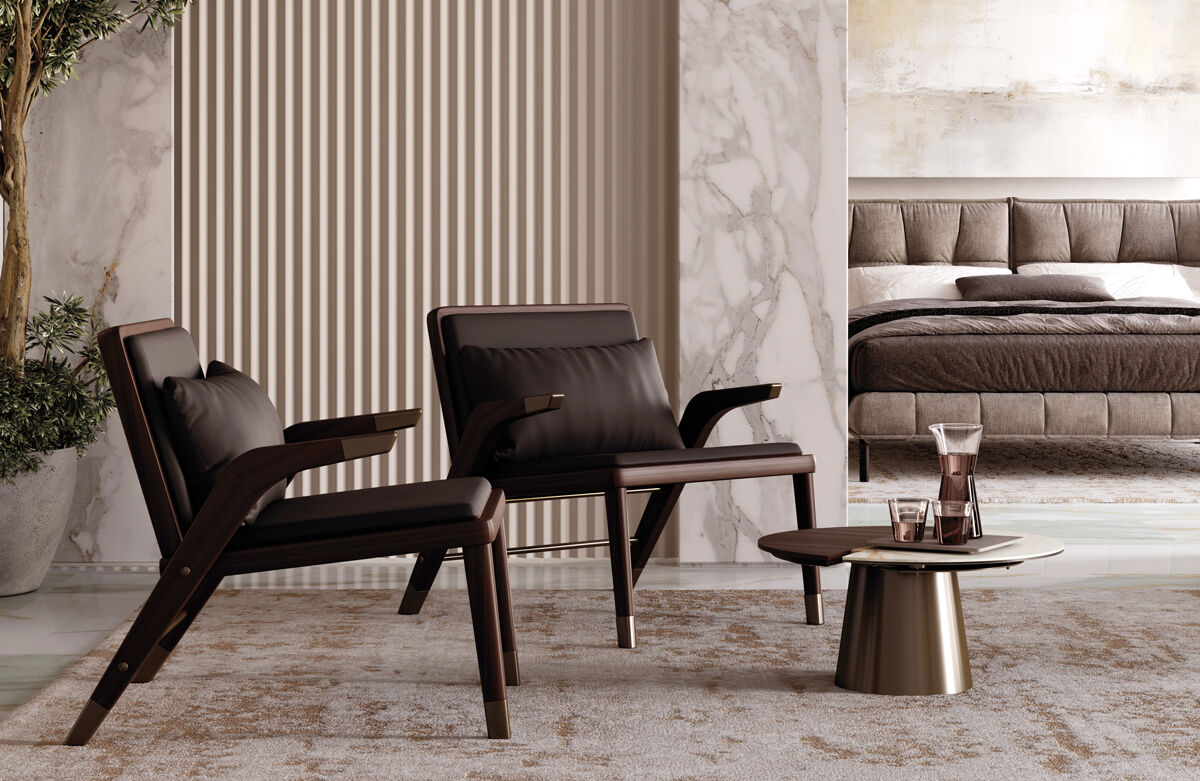
Kodi, designed by Andrea Arena, is built around a continuous line that envelops whoever sits in it: it’s the right armchair if your idea of comfort is feeling cocooned. Lady, by Marco Corti, works the opposite way. The solid wood frame is left exposed, with lacquered steel details, and a removable lumbar cushion supports the lower back; the armrests are 51 cm from the floor, a comfortable height for resting your forearms while you read. Petra sits halfway between the two: enveloping in the backrest, generous in the seat.
Fixed or swivel?
A swivel armchair changes the way you live in an open space: during the day you turn towards the window, in the evening towards the sofa and your guests, without moving a thing. It makes most sense in open-plan layouts and central positions, far less so in a tight corner, where there is no room to turn.
Petra, Nova, Ariel and Kodi come in both fixed and swivel versions. Doris, designed by Pocci & Dondoli and also a Red Dot Design Award winner, is swivel by nature: its cylindrical metal base lets it rotate on its own axis, and the version with return function brings it back to its starting position by itself. It’s a detail you appreciate when the armchair needs to stay aligned with the rest of the furniture, even after someone has sat in it turned towards the window.

Upholstery: fabric, velvet or leather
Upholstery is the part of the armchair you touch every day, and also the part that most changes its character. On Nova, for example, you can choose from Premium leather, Supreme Velvet, Bouquet, Gourmet and Sunrise fabrics, and Kvadrat Coda and Field fabrics. The frame has its own palette too: lacquered metal ranges from black to aged brass, by way of rose gold and white.
This season, velvet is the most natural choice. It holds colour in depth, changes shade with the light and warms up a room instantly. The Supreme Velvet range includes shades such as tobacco, hide leather, corten and emerald green, perfect if you want an armchair that gets noticed; in return, this material asks for a little more care. Leather is easy to clean and gains character over time, while fabrics remain the most versatile way to play with colour and texture.
Living room armchairs: pairing with the sofa
In the living room, an armchair never stands alone: it is measured against the sofa, and half the result depends on that relationship. There are two routes. The first is continuity: Victor, designed by Elena Trevisan, echoes the lines of the Victor sofa in a compact version, with slim metal feet and optional, gently curved armrests, making it possible to build a conversation area that is consistent in every piece. The second is contrast: a sofa with strict lines next to a soft armchair like Petra or Kodi, perhaps in a different colour. Either way, it’s worth repeating at least one element, the finish of the feet or a shade of the fabric, so that the whole stays legible.
For a complete view of the room, from the sofa to the lighting, take a look at our guide to living room furniture. If instead your armchair is destined for a corner of its own, you will find practical ideas in our articles on how to create the perfect reading nook and how to choose the ideal living room armchair.
FAQ about designer armchairs
How much space do you need for an armchair in the living room?
In the Bontempi collection, armchair widths range from 70 cm for Lady to 104 cm for Petra. To this you should add at least 60-70 cm of clear space in front of the seat, so you can stand up and walk past comfortably, and around 40-45 cm between the armchair and any coffee table.
What’s the difference between an armchair and an accent chair?
An armchair is wider and deeper and designed for relaxing. An accent chair is more compact, has a more upright backrest and also works in the bedroom, next to a desk or in the entrance hall. Nova and Ariel are examples of accent chairs; Petra, Kodi and Victor are armchairs in the true sense.
Is a fixed or a swivel armchair better?
A swivel armchair works best in open-plan spaces and central positions, where it lets you turn towards the window or the sofa without moving anything. In a tight corner, a fixed armchair is more practical. Petra, Nova, Ariel and Kodi come in both versions, while Doris is always swivel, including a version that automatically returns to its starting position.
Which upholstery should you choose for an armchair you use every day?
It depends on how you use it and the atmosphere you are after. Velvet is warm and striking but needs more care; leather is easy to clean and improves with age; fabrics offer the widest choice of colours and textures. Bontempi armchairs are available in leathers, velvets and fabrics from several collections.
Can you put an armchair in the bedroom?
Yes, and it’s one of the simplest ways to make a bedroom more liveable. Choose compact, soft models such as Doris, or narrow accent chairs such as Nova and Ariel, and place them near the window or at the foot of the bed.
How do you pair an armchair with a sofa?
You can go for continuity, choosing an armchair from the same collection, such as Victor with the Victor sofa, or for contrast in shape and colour. Either way, it is a good idea to repeat at least one element, such as the finish of the feet or a shade of the upholstery.
The right armchair is the one you stay in
You choose an armchair twice: first with a tape measure in hand, then by sitting in it. The measurements tell you whether it fits the room, but it’s your body that tells you whether it’s the right one, which is why it’s always worth trying it before you decide.
Discover all Bontempi designer armchairs, customise upholstery and finishes with the online configurator and try the models in person at your nearest retailer.
Bontempi brings the 2026
Collection to High Point Market
Dining tables for every
space: materials, shapes and sizes
Living room furniture: the
complete guide to modern style
Bontempi wins the prestigious Red
Dot Design Award for the PETRA armchair

The elegance of summer: how to
furnish sea-view living spaces

Ideas for Furnishing a
Small House with Style
Bontempi unveils the 2026
collection at Salone del Mobile.Milano
Console Tables with Mirrors: Smart
Solutions for Modern Living Rooms
Spring Home Décor: how
to refresh your interiors
